The seismic vulnerability assessment of a strategic building such as a fire station is an obligation arising from §2.4.2 of the NTC 2018, regardless of whether any works are carried out. On behalf of the Province of Monza and Brianza, and within the framework of PNRR funding, Teknoprogetti Engineering carried out the seismic vulnerability assessment of a fire station in Brianza: an on-site investigation campaign (rebound hammer, ultrasonics, SonReb method, georadar, video-endoscopy, mortar penetrometer), a three-dimensional FEM model and the determination of the iPGA risk indicators for each structural unit.
A Strategic Building with No Original Structural Documentation
As part of a PNRR-funded project, the Province of Monza and Brianza commissioned Teknoprogetti Engineering to carry out the seismic vulnerability assessment of a fire station in a municipality in the Brianza area. The building qualifies as a strategic structure under §2.4.2 of the NTC 2018 — a category for which structural assessment is not optional, but a legal obligation arising directly from the regulations, regardless of whether any construction works are planned.
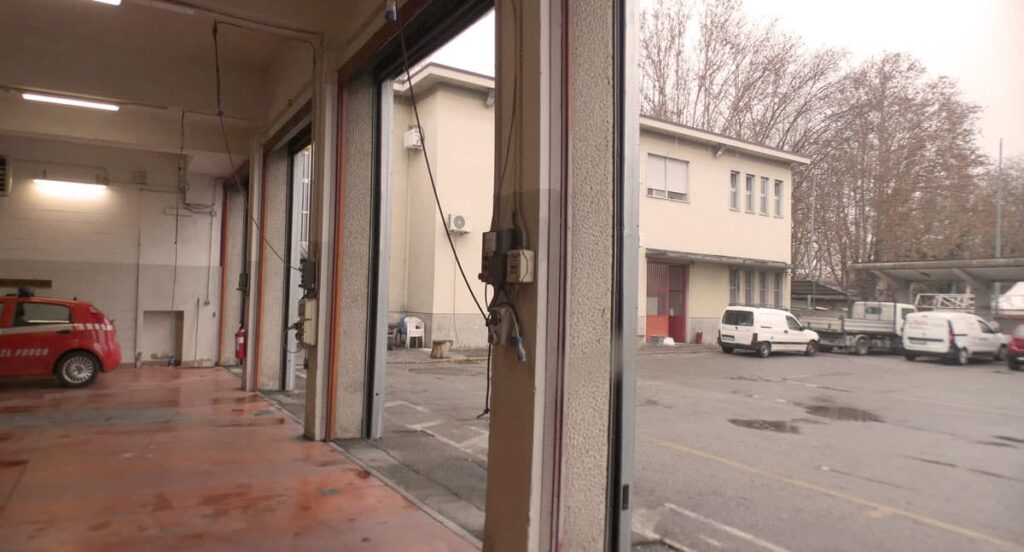
The complex consists of three independent buildings constructed at different times and with different structural technologies: the main block (two storeys above ground plus a loft), with load-bearing brick masonry walls and composite floor slabs; the warehouses, also in load-bearing masonry; and the vehicle garage, with reinforced concrete columns and a steel truss roof. No certified original technical documentation existed for the entire complex, nor was any structural design on file. The starting point, in the absence of any archive, was a blank slate.
Nine Investigation Techniques Over Two Working Days
The investigation campaign was carried out over two days on site (5 and 6 March 2025). The programme was designed to cover all the structural technologies present in the building using the most appropriate tools for each.
On the reinforced concrete columns of the vehicle garage, rebound hammer tests were performed on 7 elements, direct ultrasonic measurements on 6 columns, one core extraction with compression testing at a certified laboratory, and the combined rebound hammer–ultrasound SonReb method across the entire column bay. The deviation between the laboratory core result (25.4 N/mm² → 27.4 N/mm² after applying the disturbance factor Fd) and the SonReb estimate on the same element was 4%, well within the method’s reliability margin.
For the characterisation of the masonry in the main block and the warehouses, 32 ground-penetrating radar scans, 4 video-endoscopic investigations, 6 plaster pocket inspections and 6 mortar penetrometer tests were carried out. The steel reinforcement in the garage — floor beam sections and truss profiles — was characterised using Vickers surface hardness measurements on 9 elements.
Overall, the campaign returned data on five different floor slab types, three masonry types (solid brick, Poroton blocks, mixed masonry) and seven reinforced concrete columns distributed across the full garage bay.
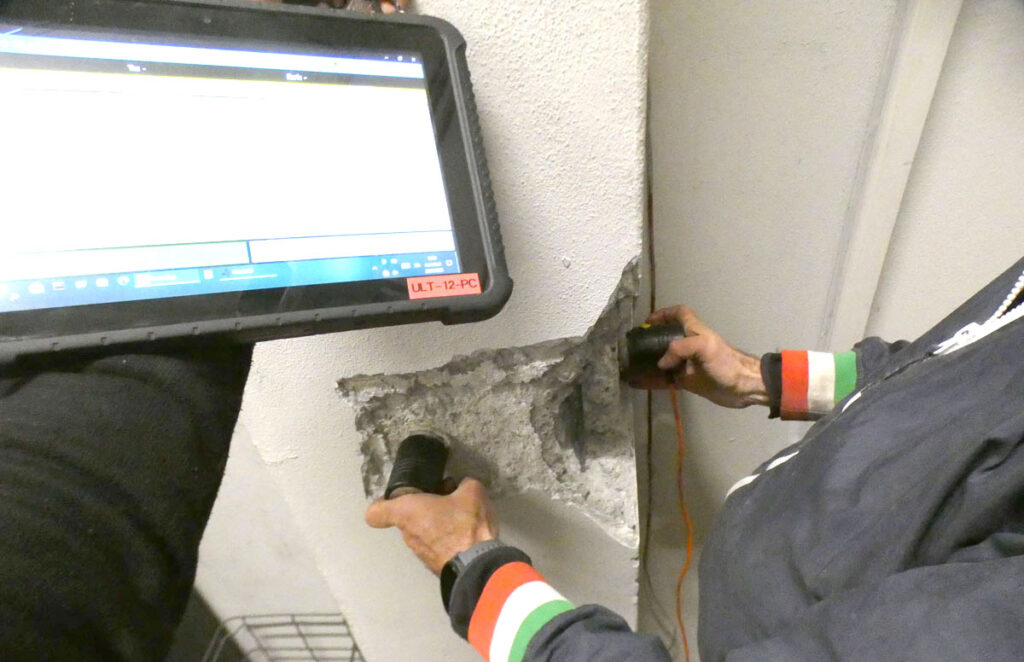
Direct ultrasonic measurement on a garage column: one of the six tests carried out during the investigation campaign of 5–6 March 2025.
What the Investigations Revealed: Degraded Concrete and Discontinuous Masonry
The results produced a picture consistent with what is typically found in public buildings constructed in successive phases, without a unified structural design.
The garage columns showed a highly marked variation in compressive strength: SonReb values ranged from 5.7 N/mm² in the most degraded columns to 28.6 N/mm² in the best-preserved ones, with an average of approximately 18.5 N/mm². These are concerning values, below the minimums achievable even with the concrete mixes used at the time of construction (at least 20 MPa). The reinforcement — plain round bars with diameters of 16–20 mm and stirrup spacing that varies considerably between columns (from 18 to 60 cm) — does not provide the ductility needed to respond adequately to seismic action. Ground-penetrating radar inspections confirmed these findings, detecting internal inhomogeneities in several elements.
The condition of the masonry in the main block is different in nature, but no less significant. Plaster pocket inspections revealed an irregular masonry texture — bricks of varying sizes, with an uneven alternation of headers and stretchers — and inconsistent mortar joints whose average surface penetrometric resistance was around 0.9 N/mm². At a corner between the perimeter wall and an internal spine wall, the inspection revealed that the two leaves are not interlocked: they are simply placed side by side, with no course interleaving. The absence of corner connections is one of the best-known vulnerabilities in pre-code masonry structures, as it can trigger out-of-plane overturning mechanisms even under low-intensity seismic action.
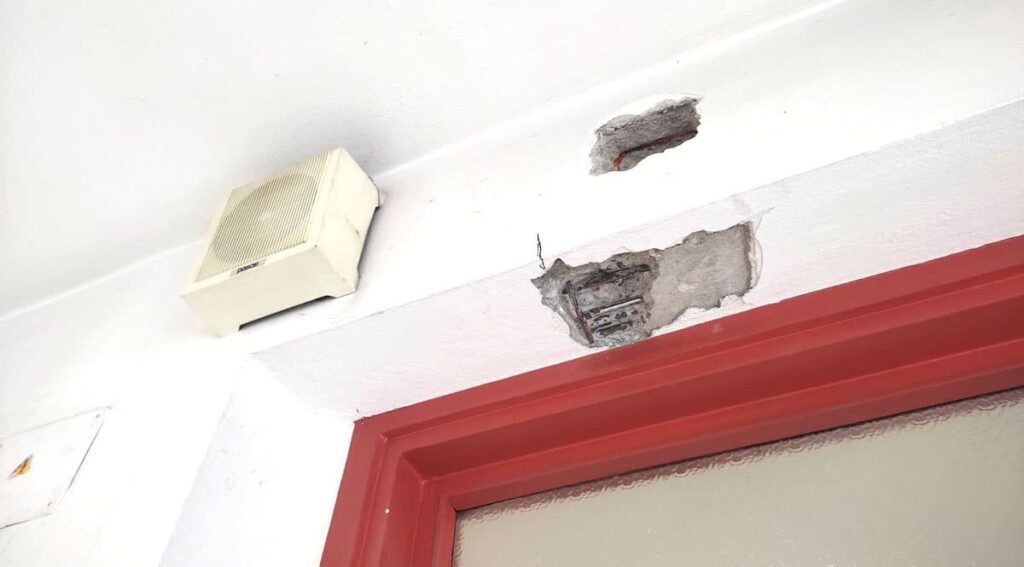
Exposed steel reinforcement on the garage floor slab: plain round bars with diameters of 16–20 mm and highly variable stirrup spacing, insufficient to ensure seismic ductility.
From the Investigation Campaign to the Structural Model
The data collected fed into a three-dimensional finite element model of the entire building complex. The vertical masonry structures were modelled using shell elements, the columns and beams using beam elements, incorporating the surveyed geometry and the mechanical properties determined on site. The knowledge level achieved is LC2 for the reinforced concrete of the garage and LC1 for the masonry of the main block and the warehouses, with the corresponding confidence factors applied to the design strengths.
The seismic vulnerability assessment carried out in accordance with Chapter 8 of Ministerial Decree 17.01.2018 led to the determination of the iPGA risk indicators for each building block. The results are clear: block A (main building) has an iPGA of 0.40, block B (warehouses) 0.10, and block C (vehicle garage) 0.10. This last value refers to the verification of the columns, which are the most critical structural elements in the entire complex. A value of 0.10 means the structure is capable of resisting only 10% of the design seismic action prescribed by NTC 2018 for a new building in the same location.
The seismic vulnerability checks showed that a significant proportion of the structural elements have a safety coefficient below 0.6 — the threshold identified by the Civil Protection Department guidelines as a reference for determining the seismic criticality of buildings in low-seismicity areas such as the one under examination.
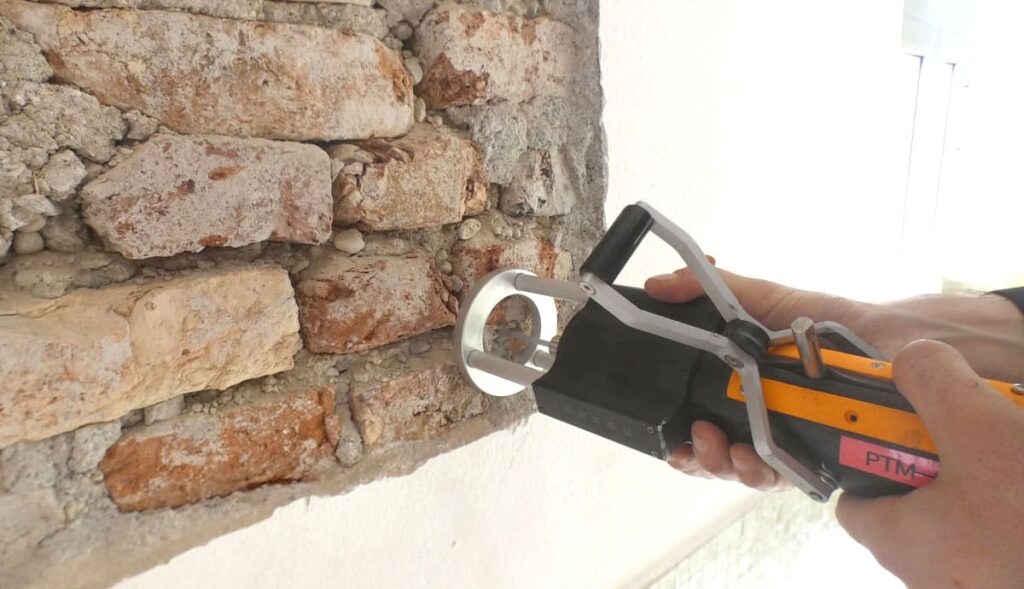
Mortar penetrometer test on solid brick masonry: the average joint resistance measured on site was approximately 0.9 N/mm², a value incorporated into the FEM model at knowledge level LC1.
Current Status and Next Steps
The seismic vulnerability assessment report was completed and delivered to the Province of Monza and Brianza in April 2025. Based on the findings, the client has initiated the design of seismic improvement works. The options under discussion include structural strengthening of the garage columns and the introduction of connection systems between the load-bearing masonry walls of the main block.
One aspect worth highlighting concerns the working method. Having both structural modelling and NDT expertise within a single team made it possible to calibrate the investigation programme around the model to be built, to interpret instrumental anomalies in the real context of the structure, and to minimise invasive testing: a single core extraction was sufficient to calibrate the SonReb method across the entire bay of seven columns. The fire station continued to operate normally throughout both days of investigation.
FAQ
- When is the seismic vulnerability assessment of a fire station or strategic building mandatory?
For strategic buildings under §2.4.2 of the NTC 2018, the assessment is an obligation deriving from the regulations, regardless of whether any works are carried out on the building. - What does an iPGA risk indicator of 0.10 mean?
It means that the structure is able to withstand only 10% of the design seismic action required by the NTC 2018 for a new structure in the same location. It is a value that indicates a severe critical condition. - Can seismic vulnerability be assessed without the original structural design?
Yes. In the absence of original documentation, knowledge of the building is built up through an on-site investigation campaign that determines the geometry and mechanical properties of the materials, reaching the LC1/LC2 levels of knowledge required by the regulations. - Do the investigations interrupt the building’s activity?
No. In the case of the fire station, the investigations were carried out over two days with the building fully operational; non-destructive techniques keep invasiveness to a minimum. - What happens after the seismic vulnerability report?
On the basis of the risk indicators, the client can begin designing seismic improvement or upgrading works, prioritising the most critical elements that emerged from the model.