In March 2025, Teknoprogetti Engineering was commissioned by the school administration — following formal approval by the competent authorities — to carry out a campaign of instrumental investigations on the timber structure of a school building under construction in the Municipality of Frassinoro (MO). The entire elevated structure is built with prefabricated Cross-Laminated Timber (X-Lam) panels. During construction, the Site Supervisor and the Works Director had visually detected moisture on several load-bearing elements: the problem had to be quantified before finishes covered everything.
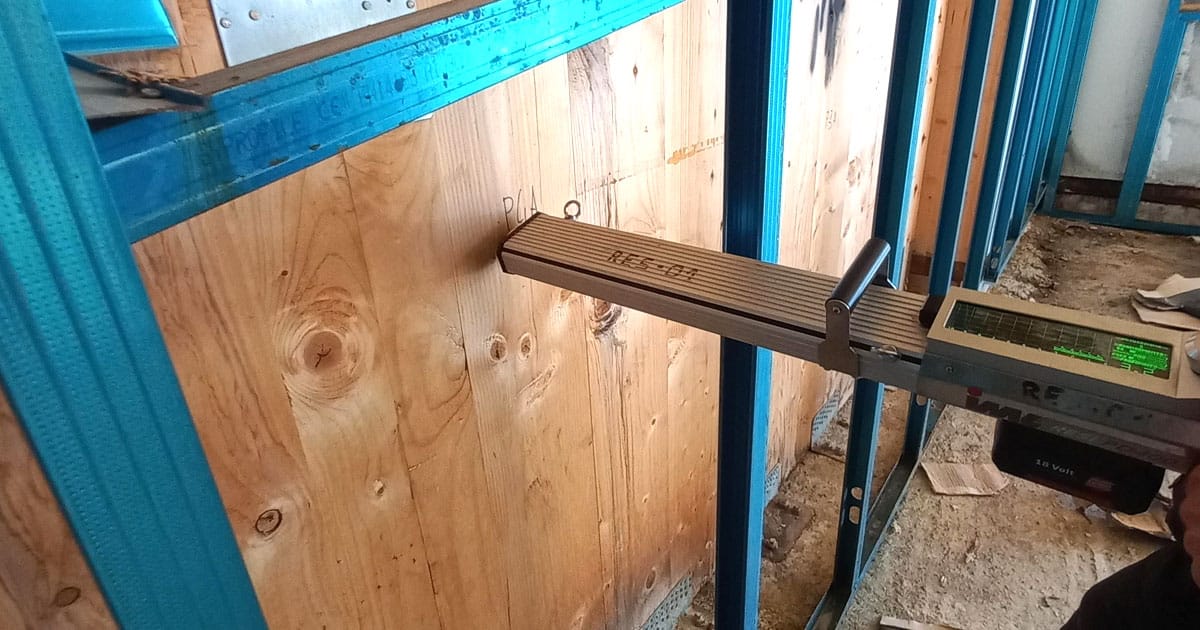
The critical point with timber structures is this: a wet X-Lam panel can look intact on the surface even when moisture has already reached the core of the section. This is why visual inspection is not enough — instrumentation is needed. This is a typical case of Non-Destructive Testing as a method of analysis. We carried out the campaign on 20 sample elements — columns, walls, portal beams, ridge beams, floor decking — for a total of 31 Resistograph measurements, supplemented by rebound-hammer tests and moisture measurements using the electrical method, in accordance with the UNI standards in force. The moisture data confirmed the localised anomalies: on the exposed window reveal, in the area below the sill, we measured 39.6% — well beyond the reference threshold for a building under construction. On the floor decking, in contact with filling material soaked with water from infiltrations through the not-yet-completed roof, the values were between 28% and 38%.
This is where the Resistograph came in: a 3 mm drill bit penetrated each element for the full depth of the cross-section, continuously measuring resistance to penetration. The result — all 31 measurements — showed constant, homogeneous profiles with no drops in the curve that would indicate rot, voids or layer separation.
The diagnosis was clear: infiltrations had increased moisture locally, but biological decay had not had time to compromise the internal structure of the panels. No structural elements needed replacement. The Works Director was able to prescribe targeted controlled drying measures and monitoring, avoiding invasive intervention and additional construction time.
High moisture in timber is a signal that cannot be ignored — but it is not automatically structural damage. The difference lies in correct instrumental diagnosis.
→ Read the full technical guide: methodology, standards, operational checklist and the complete results from the Frassinoro case.