Seismic Improvement of a Nursery School: From Vulnerability Assessment to PNRR-Funded Project
The seismic improvement of an existing school building starts with understanding the structure: diagnostic investigations, numerical modelling and risk indicat… The seismic improvement of an existing school building starts with understanding the structure: diagnostic investigations, numerical modelling and risk indicators. Teknoprogetti Engineering followed a nursery school in Vimercate — a 1930s load-bearing masonry building — from the seismic vulnerability assessment (iPGA ζE = 0.41) through to the PNRR-funded improvement project, reinforcing the masonry piers with a basalt-fibre and stainless-steel FRCM system, UHTSS top ring beams and replacement of the roof-truss tie rods.
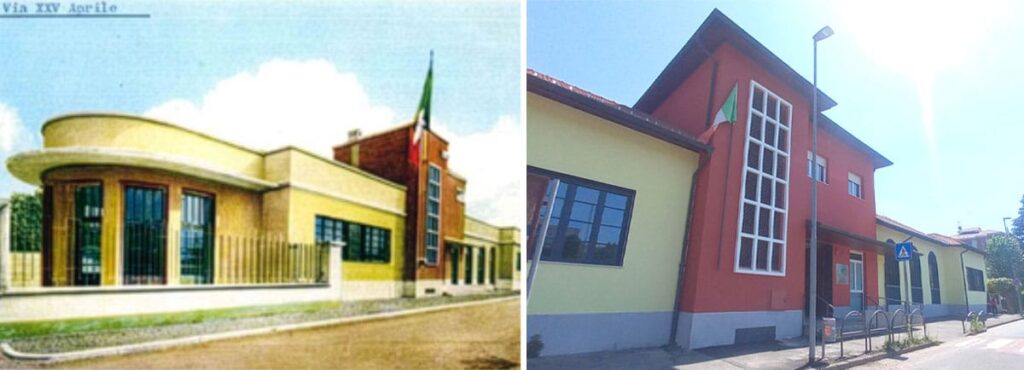
The building in the original 1939 postcard (Via XXV Aprile) and the nursery school’s main façade after the seismic improvement work
The path that led to the structural intervention on a nursery school in Vimercate is a concrete example of how in-depth knowledge of an existing building — built up over time and updated with new investigations — becomes the indispensable basis for designing effectively and without waste.
It all began in 2014, with a first diagnostic campaign carried out on the building: a historical-critical analysis of the structures, a visual survey, a load analysis and georadar investigations. That campaign produced an initial seismic vulnerability assessment, capturing the building’s as-is condition and identifying the main critical issues.
Eight years later, in February 2022, that assessment was supplemented with new penetrometric tests on the mortar and an update of the numerical model, needed to refine the mechanical characterisation of the materials. The resulting picture was clear: the building — a load-bearing masonry complex in solid brick and lime mortar, with hollow-clay-and-concrete floor slabs and a timber roof, spread over two storeys above ground — showed significant seismic vulnerability.
The calculated iPGA (ζE) parameter is 0.41, with a PAM risk class of level G and an IS-V class of level F, referring to the masonry, identified as the critical element of the entire building. Access to PNRR funds offered the opportunity to turn diagnosis into action.
The existing structure
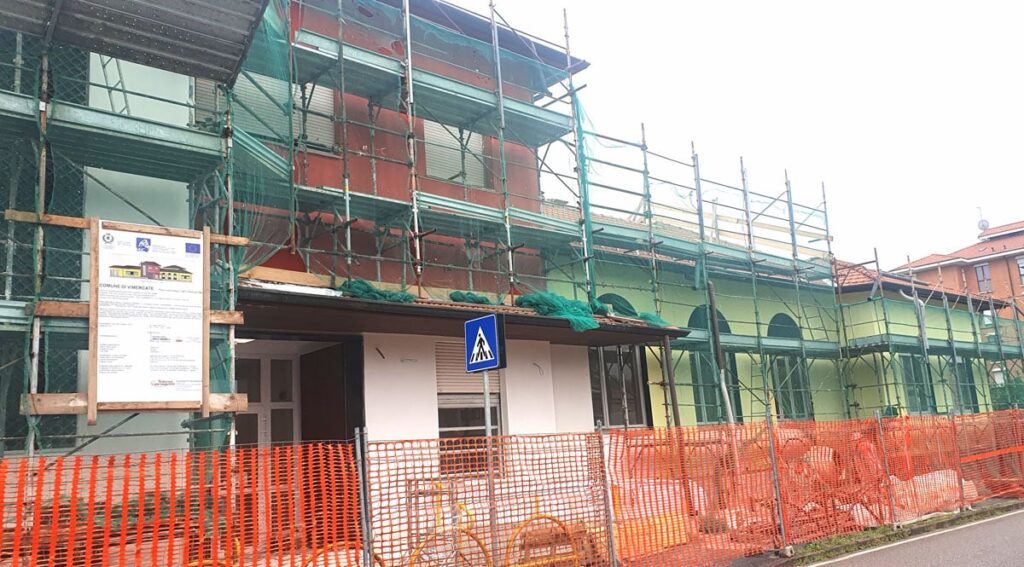
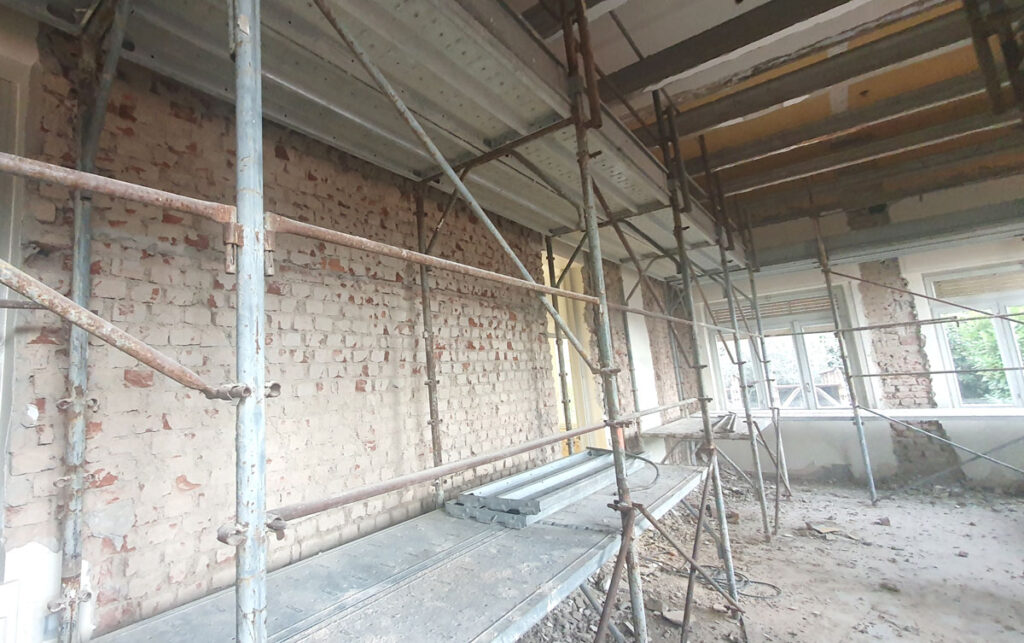
The site at the start of works: scaffolding covers the entire main façade
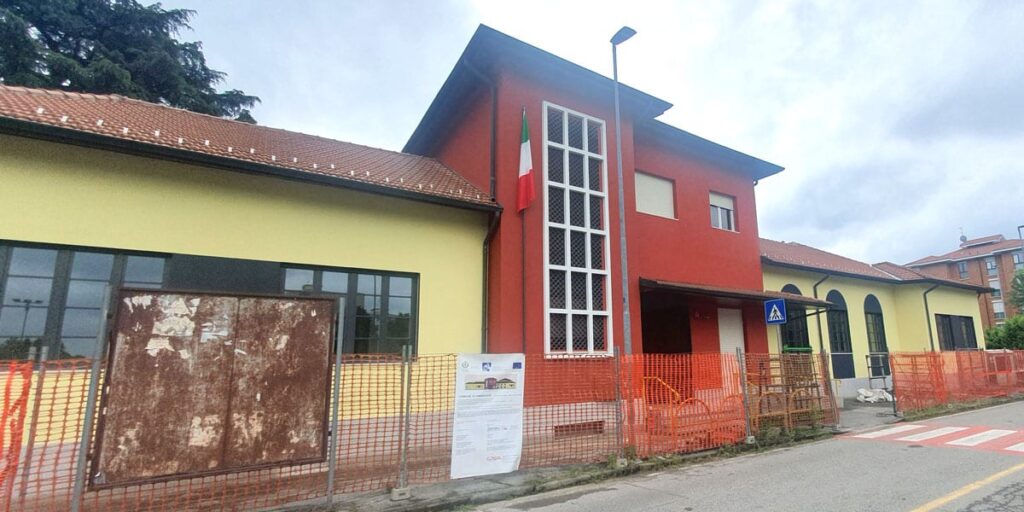
The façade at the end of works, with site fencing still in place
The building consists of two structural units, both with two storeys above ground. The vertical seismic-resisting structures are made of solid brick masonry, with reinforced-concrete columns and beams as secondary elements. The floor slabs are in hollow-clay-and-concrete, and the roof is timber.
The numerical model was developed using SISMICAD v.12.19 software, adopting a linear dynamic analysis and an LC2 knowledge level. The materials identified during the investigation are: FeB 22K steel, Rc 250 kg/cm² concrete, and load-bearing masonry with fm = 32 kg/cm² and τm = 0.76 kg/cm².
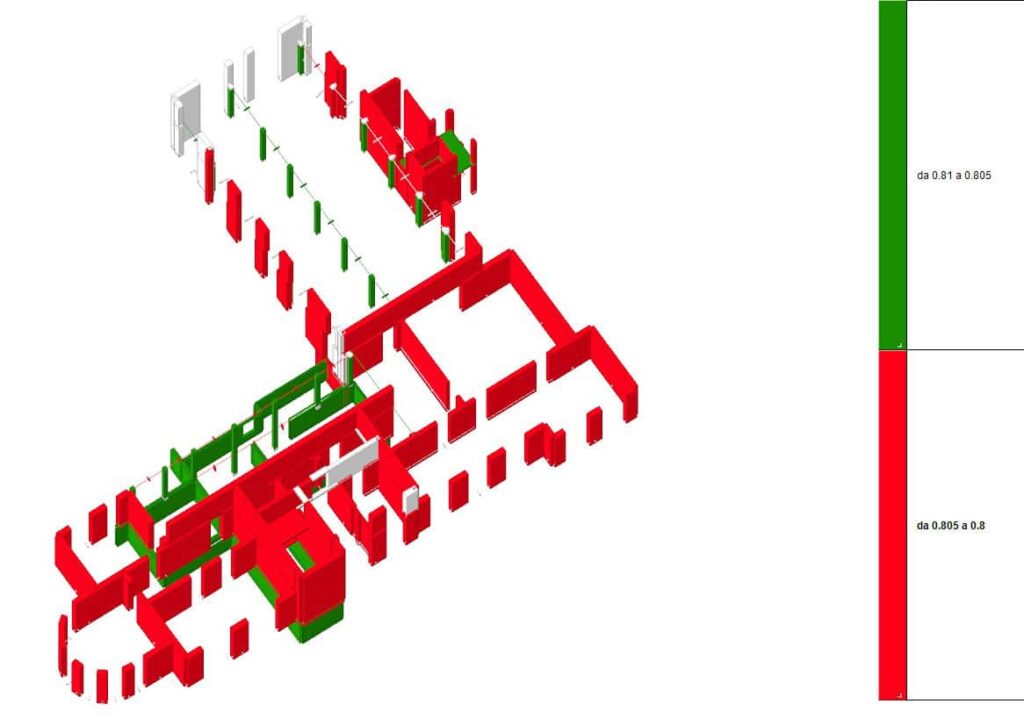
The verification results show that, in the as-is condition, a significant proportion of the masonry piers fail to meet seismic-action requirements — highlighted in red in the model’s summary maps — with safety factors well below the 0.80 threshold required by the PNRR.
Pre-intervention seismic verification map: the predominance of red highlights the masonry piers with a coefficient below 0.80
The intervention strategy
Interior view: internal scaffolding for the placcaggio of the masonry piers
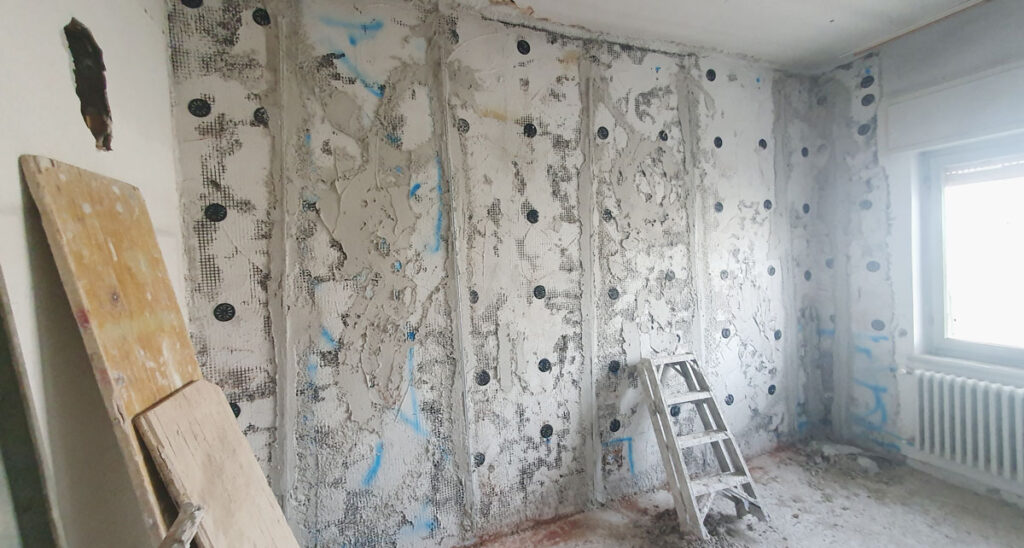
FRCM system applied: basalt-fibre mesh embedded in geomortar with stainless-steel connectors
The seismic improvement project is structured around four main categories of intervention, each designed to address a specific structural weakness.
Strengthening of the masonry piers. This is carried out by strengthening with an FRCM (Fibre Reinforced Cementitious Matrix) system: a balanced biaxial mesh in basalt fibre and AISI 304 stainless steel, embedded in two layers of NHL 3.5 lime-based geomortar, applied to single or double wall faces on the raised ground floor and the first floor. Before application, the surfaces are prepared by removing the existing plaster and repointing the joints; the fabric is anchored to the masonry with 8 mm AISI 316 stainless-steel helical bars, certified to EN 845-1.
Top ring beams. These are created by strengthening with strips of ultra-high-tensile galvanised steel fabric (UHTSS), laid at the underside of the floor slab on both the raised-ground-floor roof deck and the first-floor one. The intervention creates a stiff ring at the top of the masonry, distributing loads evenly and reducing the risk of local overturning of the individual piers.
Strengthening of the masonry columns. Confinement with strips of the same UHTSS fabric improves the ductility and strength of the columns supporting the roof’s load-bearing elements at the attic level.
Replacement of the roof-truss tie rods. The existing tie rods are replaced with new S275 galvanised-steel ties — complete with 400×200×8 mm anchor plates — eliminating the horizontal thrust transmitted from the roof to the masonry, one of the primary causes of vulnerability in historic buildings with timber structures.
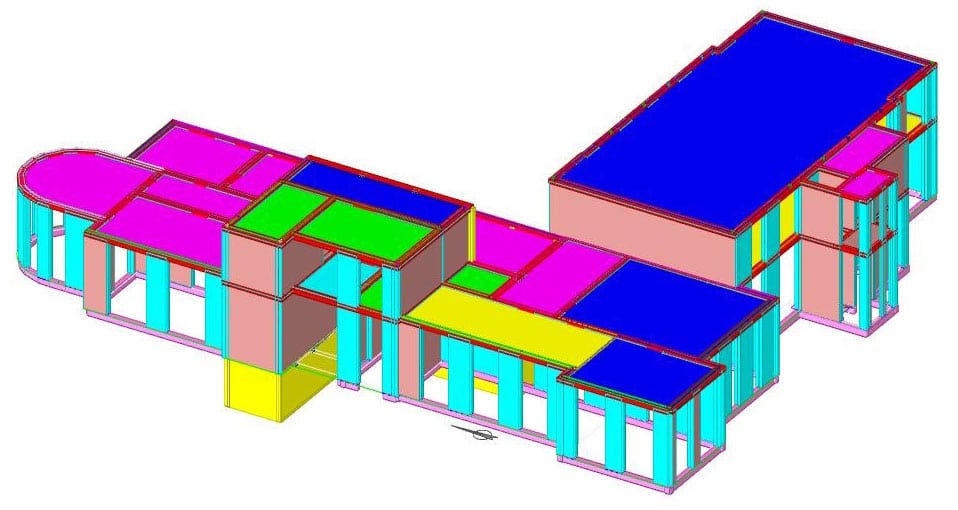
Structural model: classification by construction type — ground-floor and first-floor view.
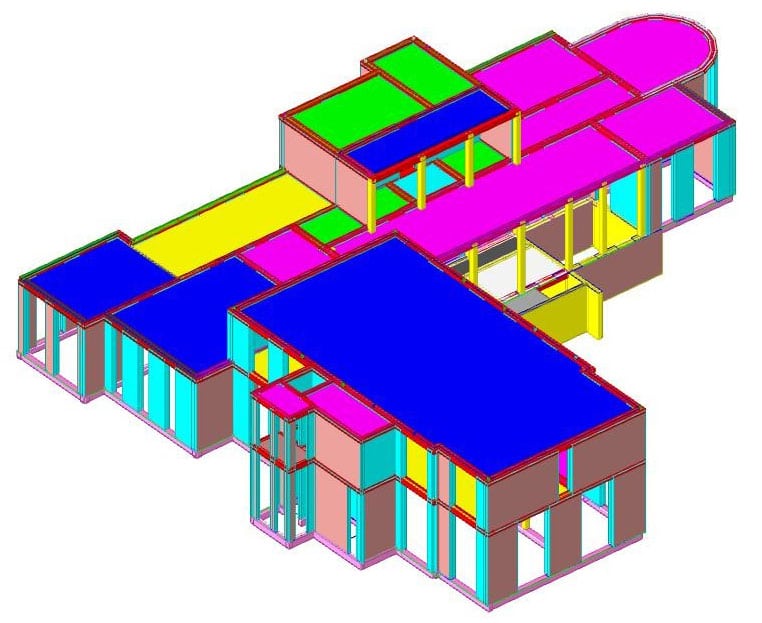
Structural model: classification by construction type — ground-floor and first-floor view.
Post-intervention verification results
The effectiveness of the project is verified using SISMICAD software and the reinforcement system manufacturer’s GeoForce One software, the latter used for the checks on the selected piers.
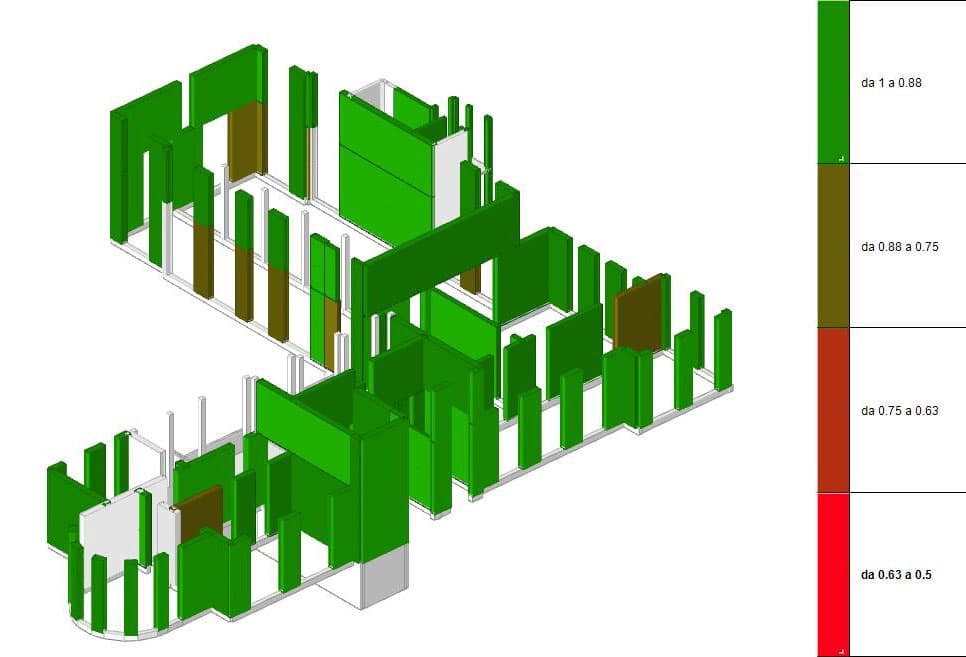
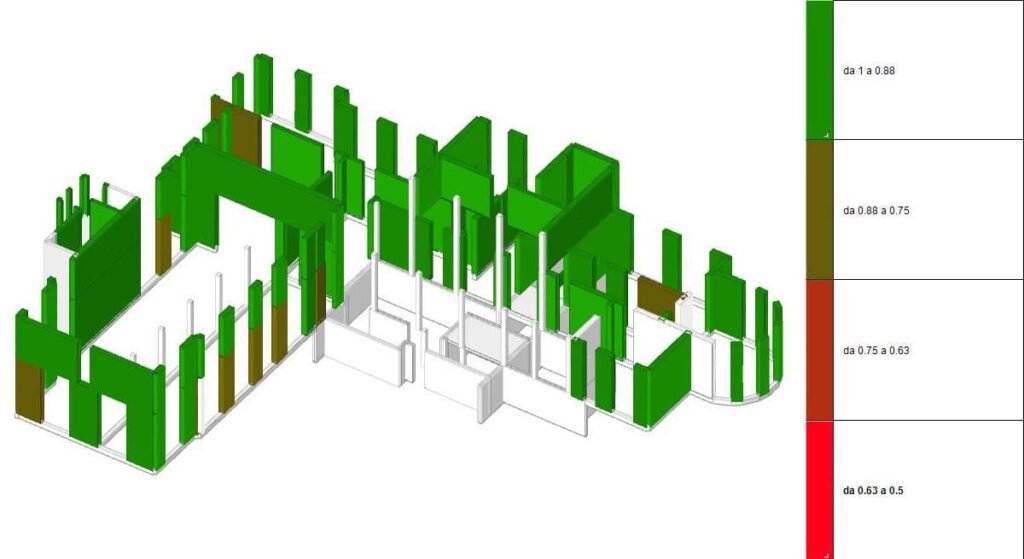
The model maps, which showed extensive red zones in the pre-intervention configuration, are now entirely green in the post-intervention configuration, with all the masonry piers reaching or exceeding the minimum safety factor of 0.80 required by the PNRR.
Post-intervention verifications — unit A: all piers in green confirm that the 0.80 threshold has been exceeded.
Post-intervention verifications — unit B: the entirely green distribution confirms the effectiveness of the FRCM strengthening.
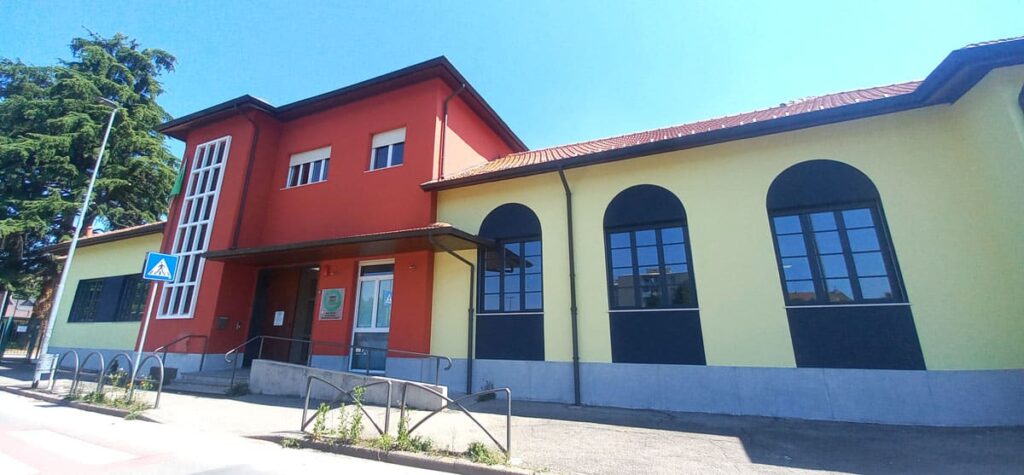
The nursery school’s side façade with the works completed: the original arches and new windows return the building to the city.
A methodological note
As in the case of the fire station, this project illustrates an aspect often underestimated in professional practice: the value of investigations carried out years before the design stage. The 2014 campaign, with the georadar survey and the thorough on-site inspection, built up a base of knowledge that in 2022 only needed updating — with targeted tests on the mortar — to produce a reliable model.
Without that earlier work, the path towards PNRR funding would have been longer and more uncertain. In this case, the continuity of technical knowledge about the building proved to be a resource as valuable as the intervention itself.
FAQ
What seismic safety factor does the PNRR require for school buildings? The verifications must reach or exceed the 0.80 threshold on the masonry piers; in the as-is condition, the values were well below it.
What is the FRCM system and why is it used on historic masonry? It is a cementitious-matrix reinforcement with a fibre mesh (here basalt and AISI 304 stainless steel) embedded in lime geomortar: it increases the strength and ductility of the masonry without heavily altering its nature, making it compatible with historic buildings.
What is the purpose of investigations carried out years before the design? An earlier diagnostic campaign (here the 2014 georadar survey) provides a base of knowledge that, once updated with targeted tests, speeds up the structural modelling and makes it more reliable.
Why are the roof-truss tie rods replaced? To eliminate the horizontal thrust transmitted from the timber roof to the masonry — one of the primary causes of vulnerability in historic buildings.
How much does safety improve after the intervention? In the post-intervention model, all the masonry piers reach or exceed the required 0.80 threshold, moving from extensive critical issues (red) to a fully verified configuration (green).