Seismic vulnerability of an industrial warehouse: how to gain two risk classes with mechanical connections
In precast industrial buildings constructed before 2008, seismic vulnerability lies not in the strength of the materials, but in the absence of mechanical connections between beams, columns and roof tiles — the collapse mechanism that emerged dramatically in the 2012 Emilia earthquake. Teknoprogetti Engineering assessed the seismic vulnerability of a production complex in Brugherio (MB) for Seriana Edilizia, taking Building B from Risk Class C to Risk Class A on the IS-V scale (iPGA from 0.53 to 0.96) by installing certified mechanical connections at the critical joints.
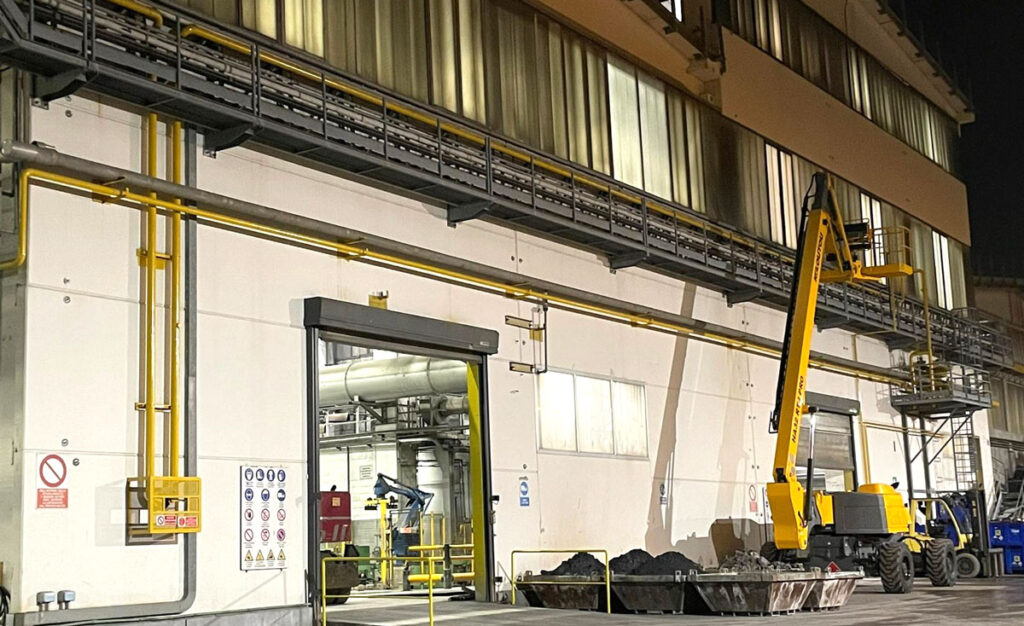
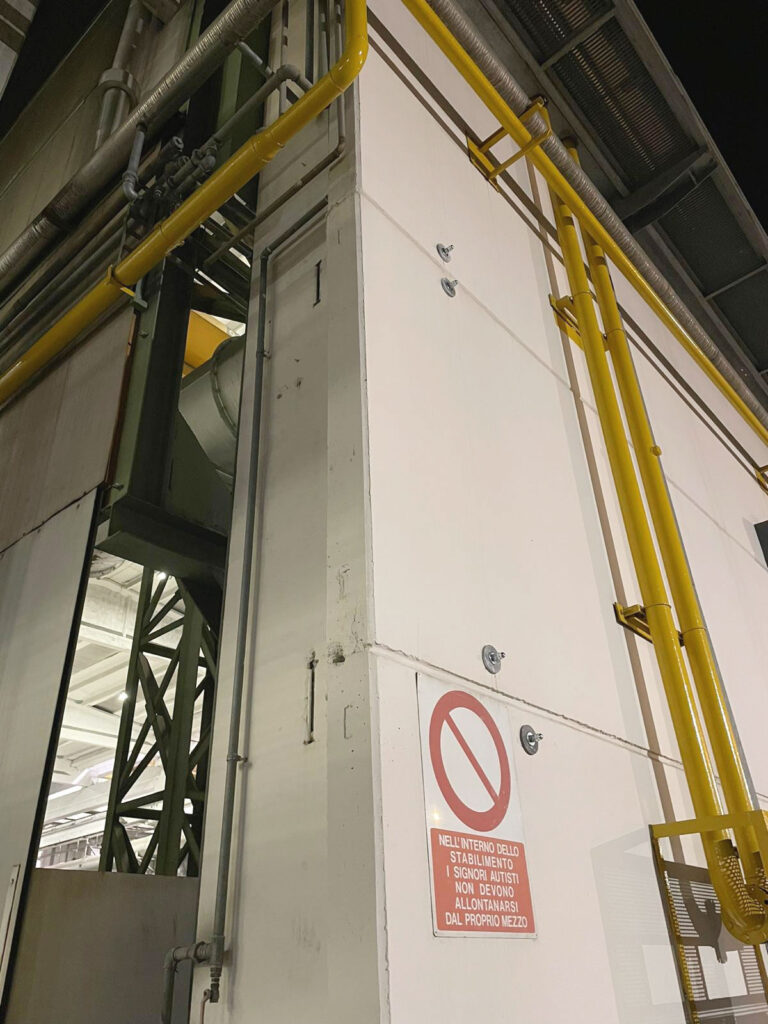
Exterior view of the industrial building in Brugherio (MB): one of the five precast buildings covered by the seismic vulnerability assessment
When it comes to the seismic safety of industrial buildings, the issue of structural connections in precast buildings is one of the most underestimated — and one of the most dangerous, as the 2012 Emilia earthquake dramatically taught us. The case presented here, developed for Seriana Edilizia on a production complex in Brugherio, is a concrete example of what it means to carry out a serious assessment of structures built before 2008, the year in which seismic design became mandatory in Lombardy.
The production complex: five buildings, the same construction logic
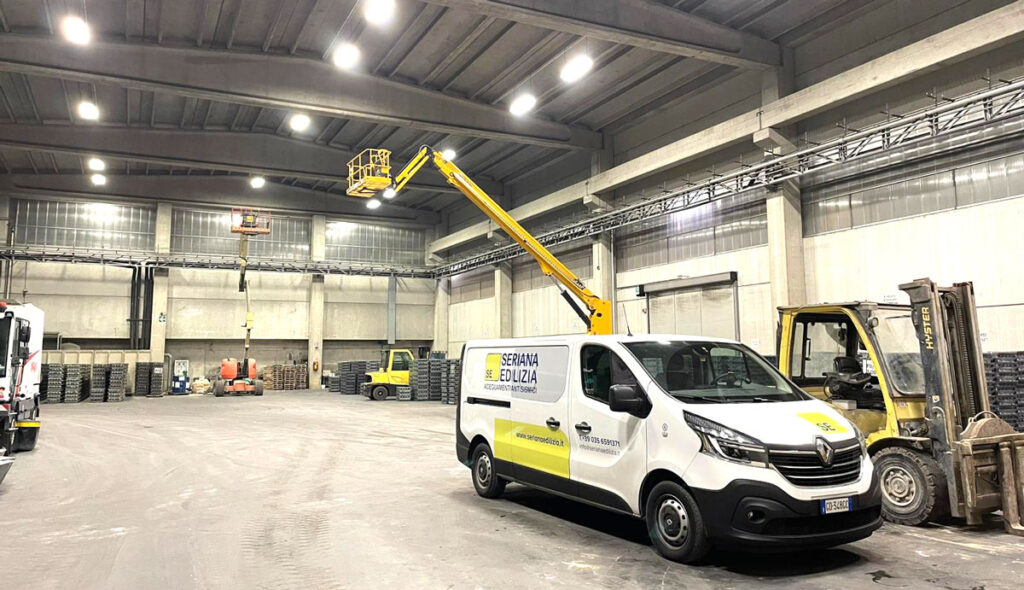
The industrial complex in Brugherio: five single-storey buildings with cast-in-situ and precast reinforced-concrete structures
The complex under investigation consists of five buildings, all single-storey, with reinforced-concrete structures both cast in situ and precast. We focus here on Building B, which is overall the most instructive case for understanding where the real vulnerability of these structures lies and how it is possible to intervene in a targeted way.
The five buildings share the same construction logic: columns in cast reinforced concrete or precast prestressed reinforced concrete, double-pitch or box girders, and precast double-T roof tiles. The roofing is uniform across the whole complex — a waterproof membrane is laid over the tiles, then a corrugated metal sheet onto which the photovoltaic panels are anchored. No original structural drawings were found, but the absence of cracking or deformation patterns attributable to the foundations made it possible to rule out investigations at that level, as provided for by the 2018 Ministerial Decree.
The investigation campaign: methods and material characterisation
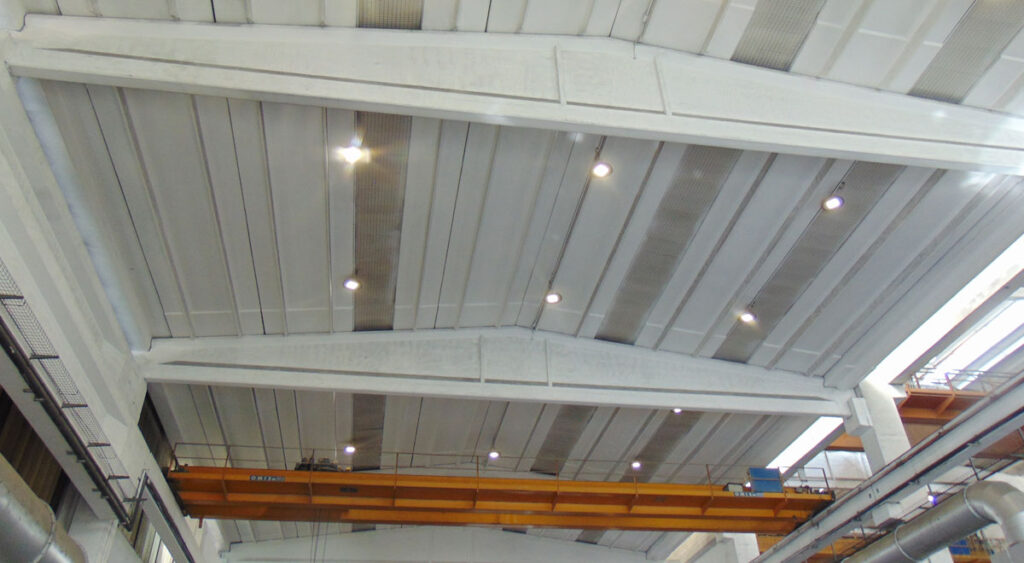
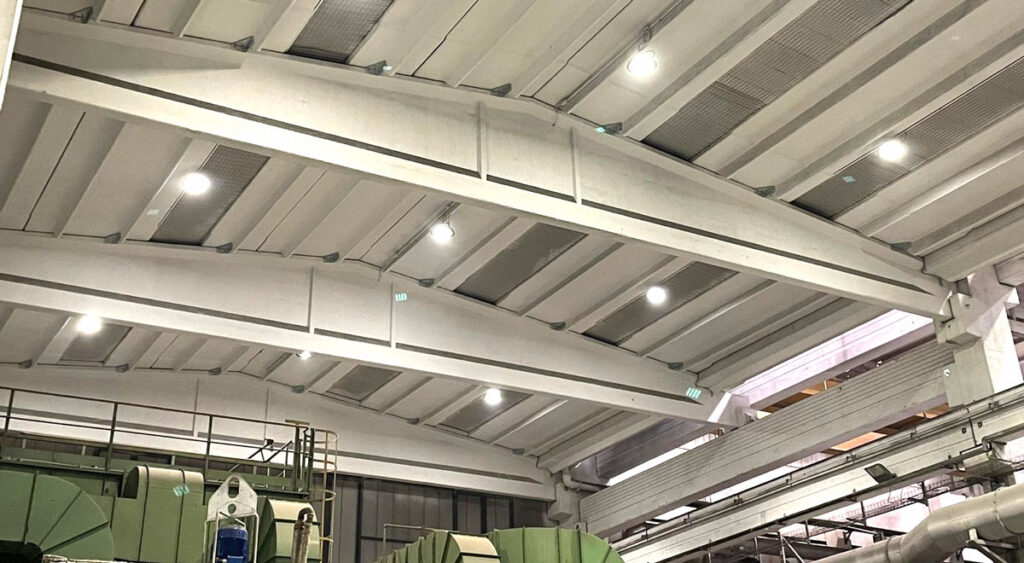
Interior view of the roof: the precast double-T roof tiles rest on the beams without mechanical connections — the main factor of seismic vulnerability
The investigation campaign, carried out through repeated site visits between September and October 2021, included sample non-destructive testing on the columns and beams of all five buildings: combined rebound-hammer and ultrasonic tests to estimate the strength of the concrete, processed using the Gasparirik and Di Leo-Pascale methods.
The results show concrete generally in good condition, with average strengths varying significantly from one building to another. In Building B, the columns show average values between 61 and 88 N/mm², while the roof beams range between 52 and 76 N/mm², with FeB44k steel common to all the structures. The level of knowledge achieved is LC2, with a confidence factor FC = 1.20 applied to all elements.
Vulnerability in the as-is condition: why the structure does not withstand an earthquake
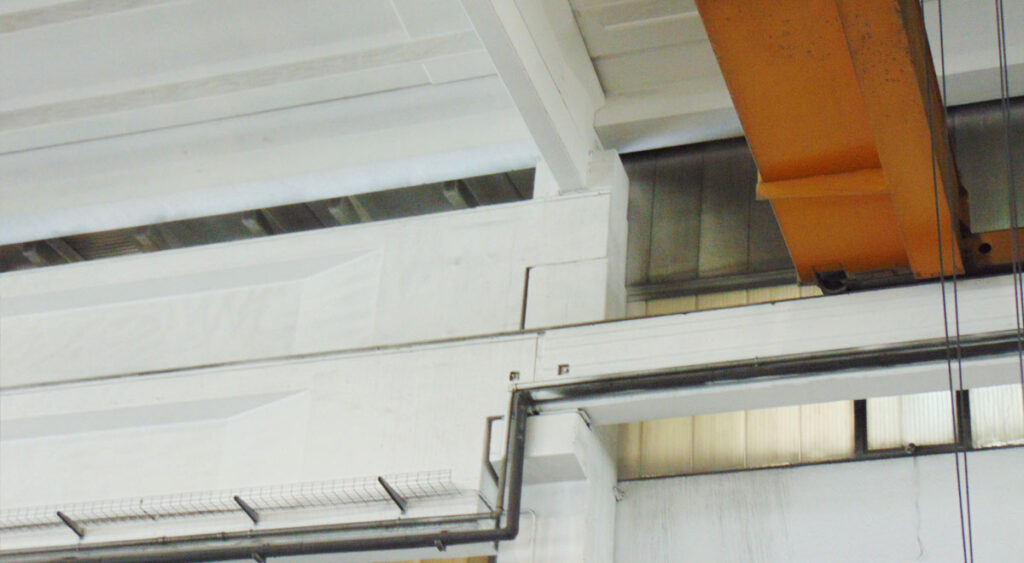
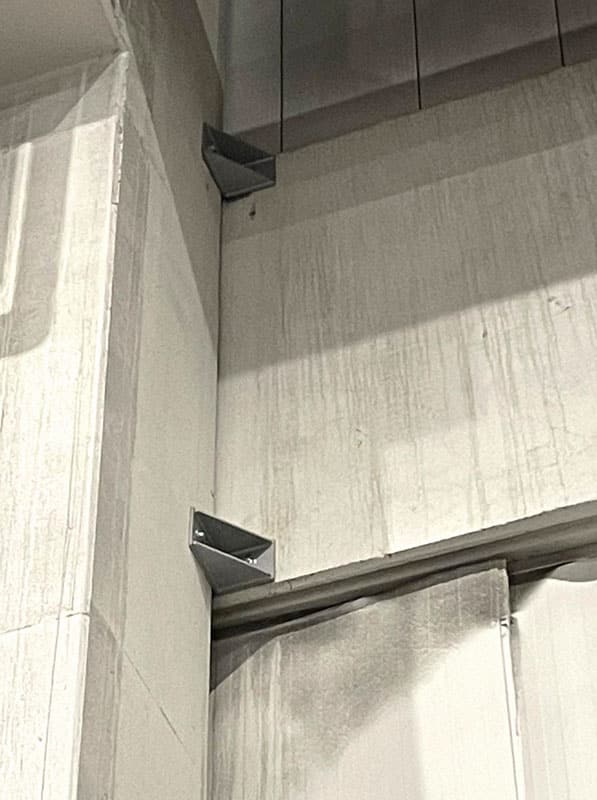
Beam-column joint in the as-is condition: the absence of mechanical connections exposes the structure to the risk of the roof tiles losing their support in the event of an earthquake
Building B, in its as-is condition, is unable to withstand the seismic actions required by Ministerial Decree 17.01.2018. The main critical issue is not in the columns or the beams — which show fairly good mechanical properties of the concrete — but in the behaviour of the assembly as a whole. The structure is essentially without mechanical connections at the beam-column and beam-tile joints, and the supports of the tiles on the beams are of limited size.
In the event of an earthquake, the horizontal displacements at the top of the columns reach values of around 7.6 cm: enough to cause the roof tiles to lose their support (the maximum displacement allowed by the geometry of the support is ≤ 4 cm) and the consequent collapse of the roof. This is a collapse mechanism that does not depend on the strength of the materials, but on the lack of restraints to prevent the precast elements from sliding out of place.
The minimum seismic risk indicator in the as-is condition is iPGA (ζE) = 0.53, with a seismic classification of Class C in terms of IS-V. The collapse mechanism is the fall of the tiles from the beams.
The proposed intervention: mechanical connections at the critical joints
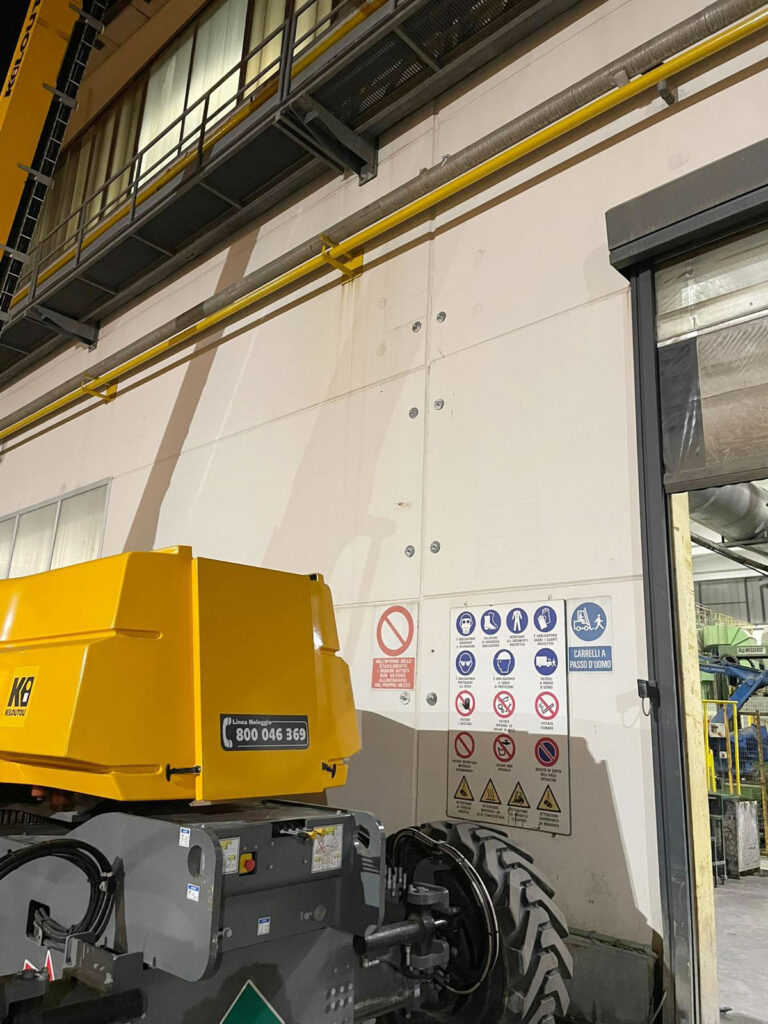
Connections between precast infill panels and columns: a complementary intervention to prevent the roof tiles from losing their support on the beams.
The mechanical connections prevent the infill panels from overturning out of their plane.
The solution does not require invasive work on the load-bearing structures. The principle is to kinematically restrain the precast elements: mechanical connections between beam and column and between beam and tile, made with certified systems designed to prevent the roof elements from losing their support. Where present, it is also advisable to make the connections between precast infill panels and the columns or panel-bearing beams.
For cases where the analysis identifies localised critical issues at the level of individual columns — as occurs for some elements of Building C — the report indicates, as an alternative or supplement, reinforcement by means of a steel cage with battens and composite systems, to restore local ductility where necessary.
The results: from Class C to Class A, with two classes of improvement
Interior view of a detail of the connection between the perimeter panel and the column: the same building, after the mechanical connections, goes from Class C to Class A of IS-V seismic risk.
The results of the model with the mechanical connections in place are clear-cut. The risk indicator rises to iPGA (ζE) = 0.9635, with the governing mechanism shifting from the roof tiles losing their support to the bending of the columns — that is, from a brittle, sudden collapse to a more ductile and controllable structural mechanism.
In terms of seismic classification, Building B goes from Class C to Class A of IS-V, with an analytical improvement of two classes pursuant to Ministerial Decree 28/02/2017 — Sismabonus Guidelines.
Why this case is worth telling
Across Italy there are tens of thousands of industrial buildings constructed in the 1970s, 1980s and 1990s with this structural logic: precast columns fixed at the base, beams and tiles simply resting in place, no mechanical connections. The 2012 Emilia earthquake showed dramatically how this category of building collapses through the loss of support of the roof elements, well before the columns reach their ultimate strength.
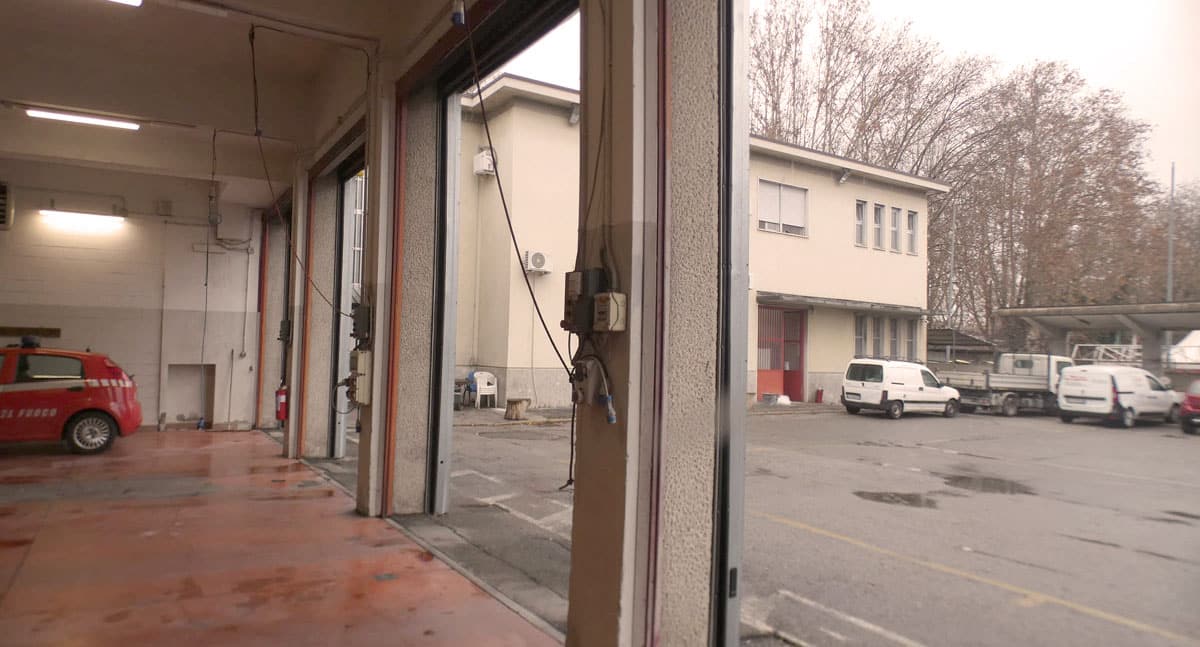
Carrying out a vulnerability assessment on these buildings, as on a nursery school or a fire station, means first of all understanding what the expected collapse mechanism is, not just measuring the strength of the materials. And intervening often means little in the way of heavy structural work — no demolitions, no enlarging of columns — but point connections at the joints that completely change the seismic behaviour of the building.
This is the kind of result that makes a vulnerability assessment an investment, not just an obligation.
FAQ
Why are pre-2008 precast buildings seismically vulnerable? In Lombardy, the obligation for seismic design came into force in 2008; many earlier structures have beams and tiles simply resting in place, without mechanical connections.
What is the typical collapse mechanism of these structures? The loss of support of the roof tiles due to excessive horizontal displacement of the columns, before the materials reach their ultimate strength.
What are mechanical connections and why are they enough? Certified systems that kinematically restrain the precast elements at the beam-column and beam-tile joints, preventing them from sliding out of place without heavy work on the load-bearing structures.
How much can the seismic risk class be improved? In this case, Building B went from Class C to Class A of IS-V, two classes of improvement pursuant to the Sismabonus Guidelines (Ministerial Decree 28/02/2017).
Is it necessary to demolish or enlarge the columns? Often not: the intervention focuses on point connections at the joints, with steel caging only where the analysis identifies localised critical issues.